NourFit review: a closer look at restaurant-focused nutrition tracking
Published
This review was written by the NourFit team, the people who make the app. It is based on an inspection of the app, version 1.0, and its features in November 2026, not on a study with users. The screenshots come from the app running with demo data.
There are many calorie trackers, but when you eat out most of them only help after the meal. NourFit wants to help before it. It shows what to order at the restaurants around you when you want to lose weight, hold your weight or build muscle.
This review goes through the app from setting a goal to dish recommendations, logging and Progress. It also covers where NourFit falls short and who would be better served by another app.
What NourFit is
NourFit is an iPhone app that reads the lunch menus and regular menus of restaurants in Slovakia and estimates calories, protein, carbs and fat for each dish. It compares them with a personal target for that meal and sorts the menu so the best dish is on top.
The app is in English, Slovak and Czech, and it needs no account. An Android version is coming soon. At the time of writing it covers about 4,800 restaurants, most of them in Bratislava, Košice, Žilina and Nitra.
Who it’s for
NourFit is for people who often eat out and have a weight or body goal: people who have a lunch menu near work, order food at lunchtime or travel around Slovakia and don’t want to guess at every meal. That includes expats and visitors, since the app works in English.
It works for losing weight and for building muscle. For weight loss it watches calories, for muscle gain protein and enough energy take the lead.
Getting started and personal targets
At the start the app asks for a goal (lose weight, hold weight or build muscle), sex, height, weight, age and how active you are. From that it estimates resting energy with the Mifflin-St Jeor equation, multiplies it by an activity factor from 1.2 to 1.9 and adjusts it for the goal.
For weight loss it takes off 500 kcal a day, for muscle gain it adds 300 kcal. When losing weight it never goes below resting energy or below 1,200 kcal for women and 1,500 kcal for men, in line with common advice.
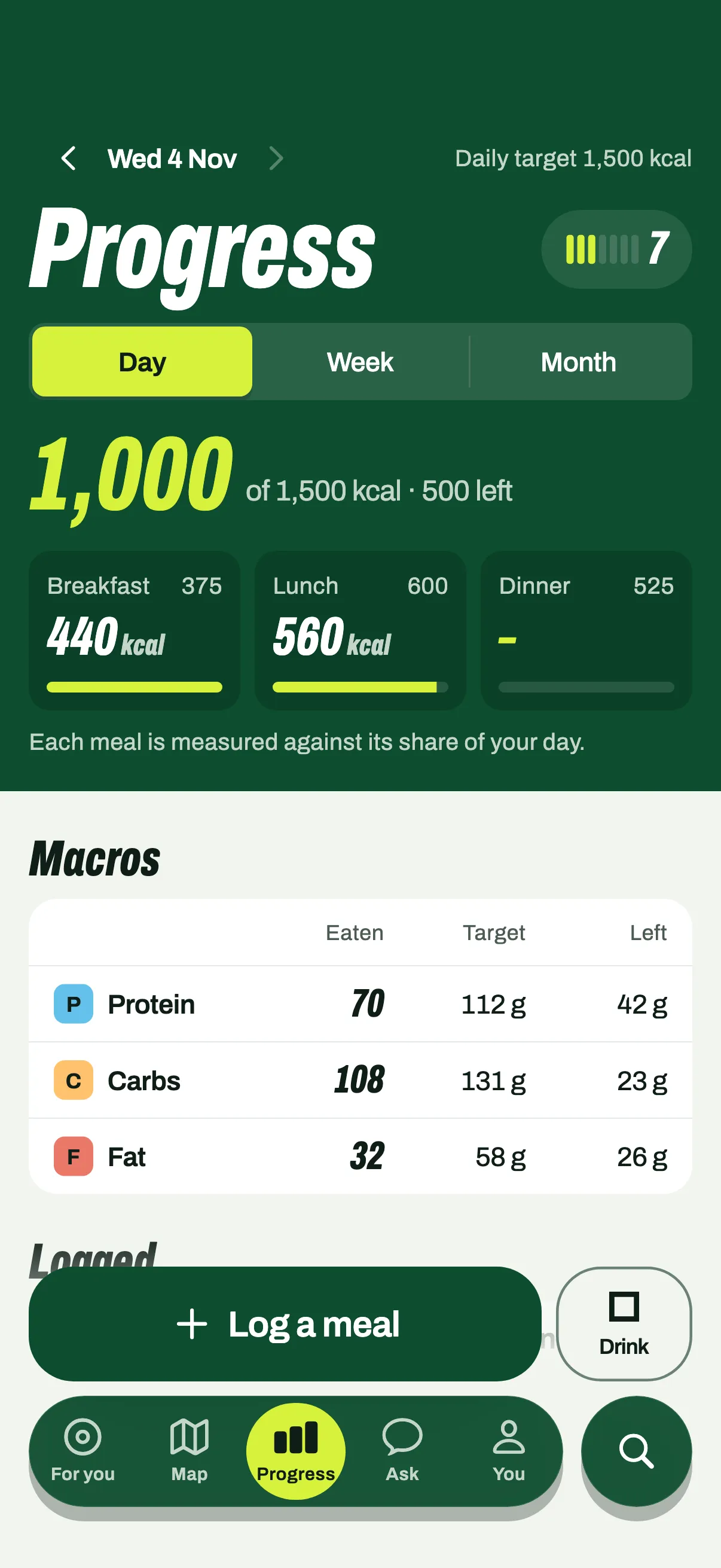
The daily target is then split between meals according to how many times a day you eat. With three meals, breakfast gets 25 %, lunch 40 % and dinner 35 %. Every meal gets a calorie range rather than a single number, plus protein, carb and fat targets in grams. Targets can be changed at any time.
It’s a sensible and transparent method, and our guide on losing weight when you eat out walks through the same maths.
Restaurants and dish recommendations
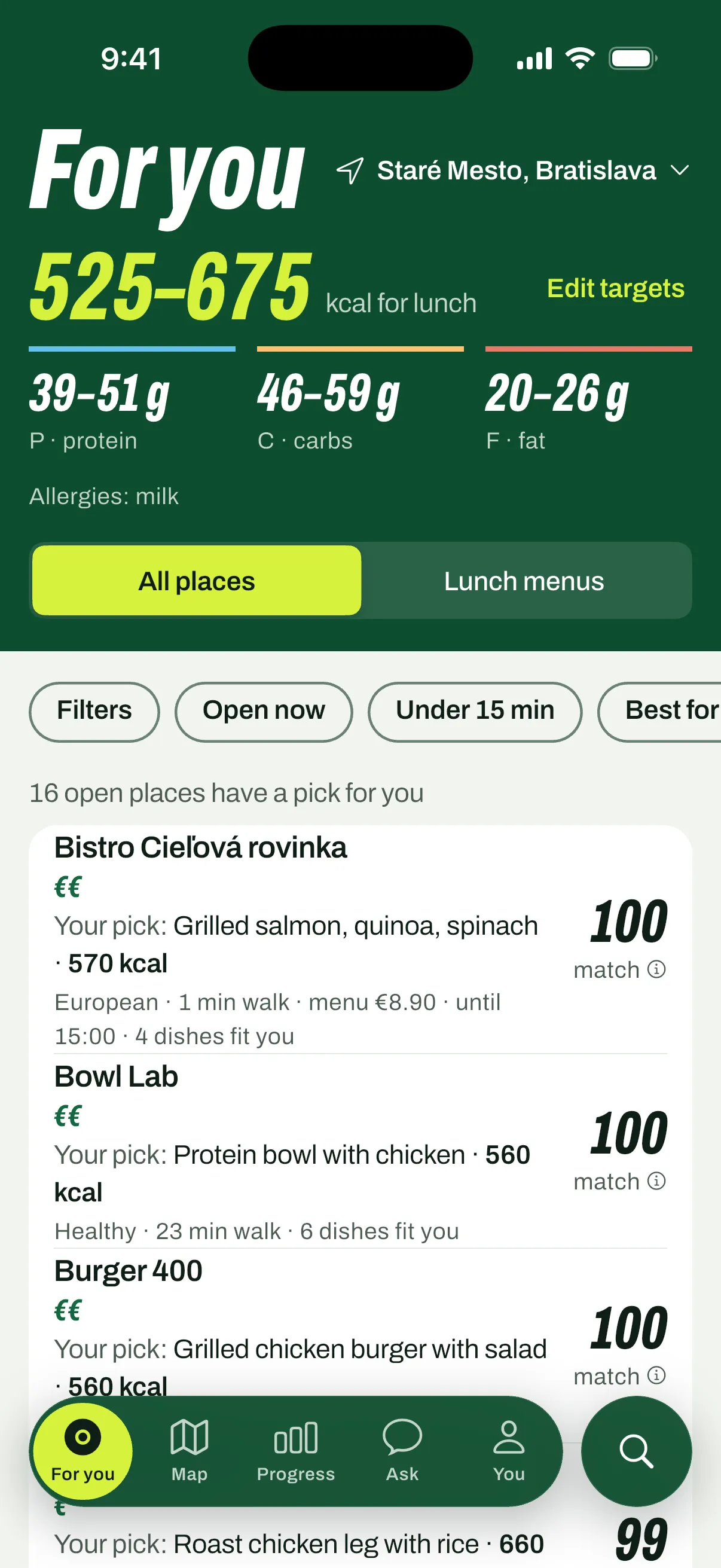
The main For you screen lists nearby restaurants. Each one shows the dish that best fits the target, its calories and a match score out of 100. A switch above the list narrows it to places with a lunch menu today.
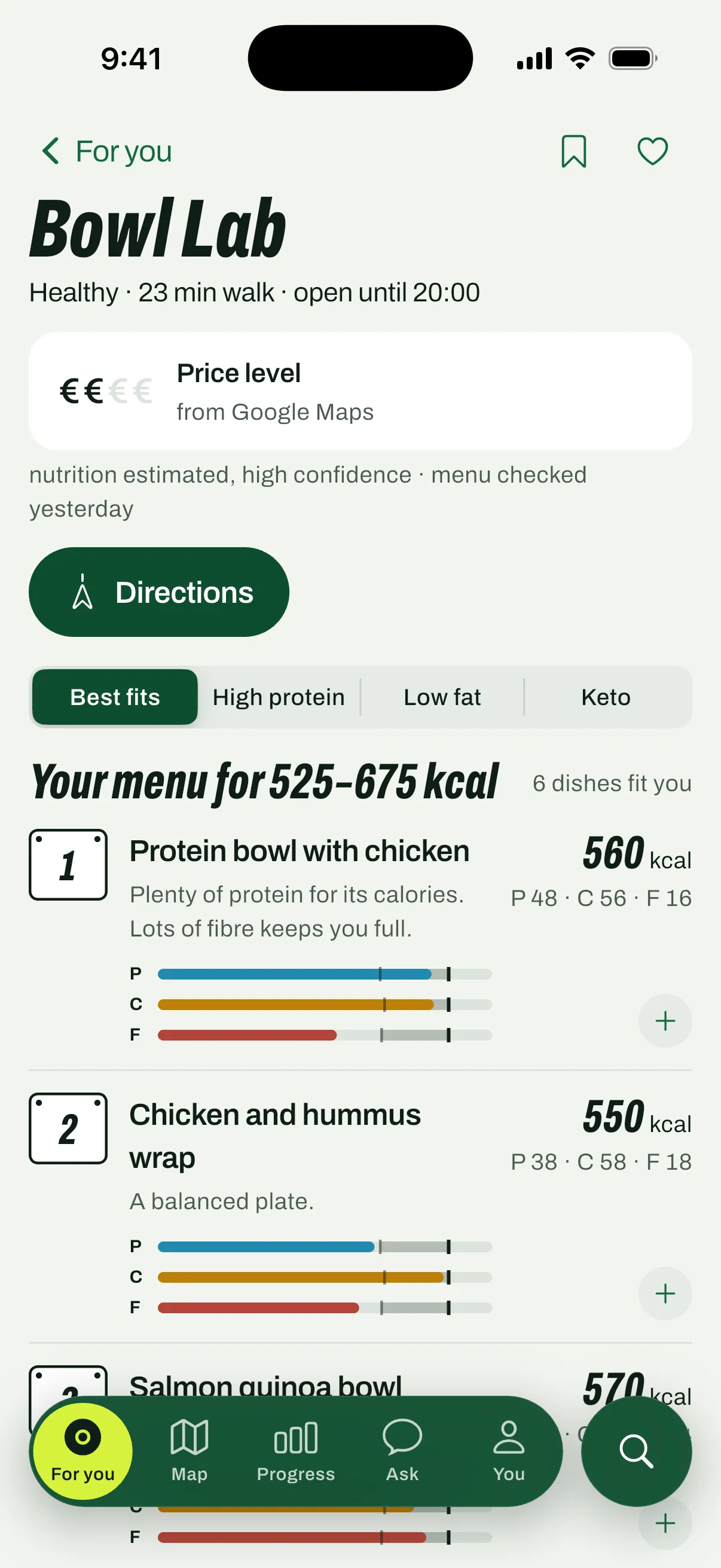
Open a restaurant and its whole menu is sorted by the target. The High protein, Low fat and Keto tabs sort it again. The restaurant page also states how reliable the nutrition estimates are and when the menu was read.
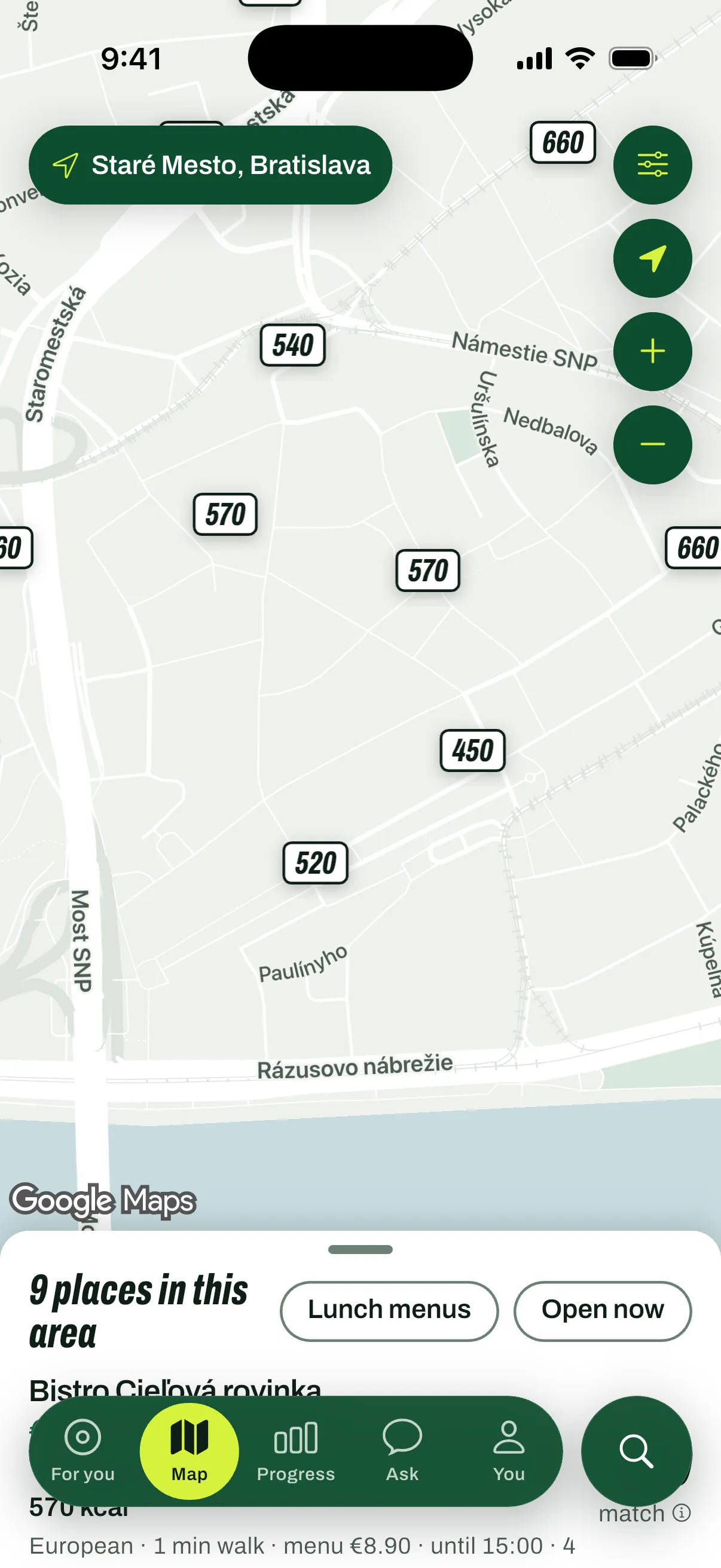
The map shows the calories of the best dish at each place, so a lighter lunch can be found without opening menus. The Ask tab answers questions about food at any restaurant.
This is where NourFit is strongest. A decision that would otherwise take minutes of reading and counting comes down to one recommendation and its number.
Calories, protein and lighter versions
A dish page shows calories in kcal and kJ and protein, carbs and fat against the target. It adds how filling the dish is and how to order it. Many dishes have a lighter version, such as a smaller portion, with exactly how many calories it saves.
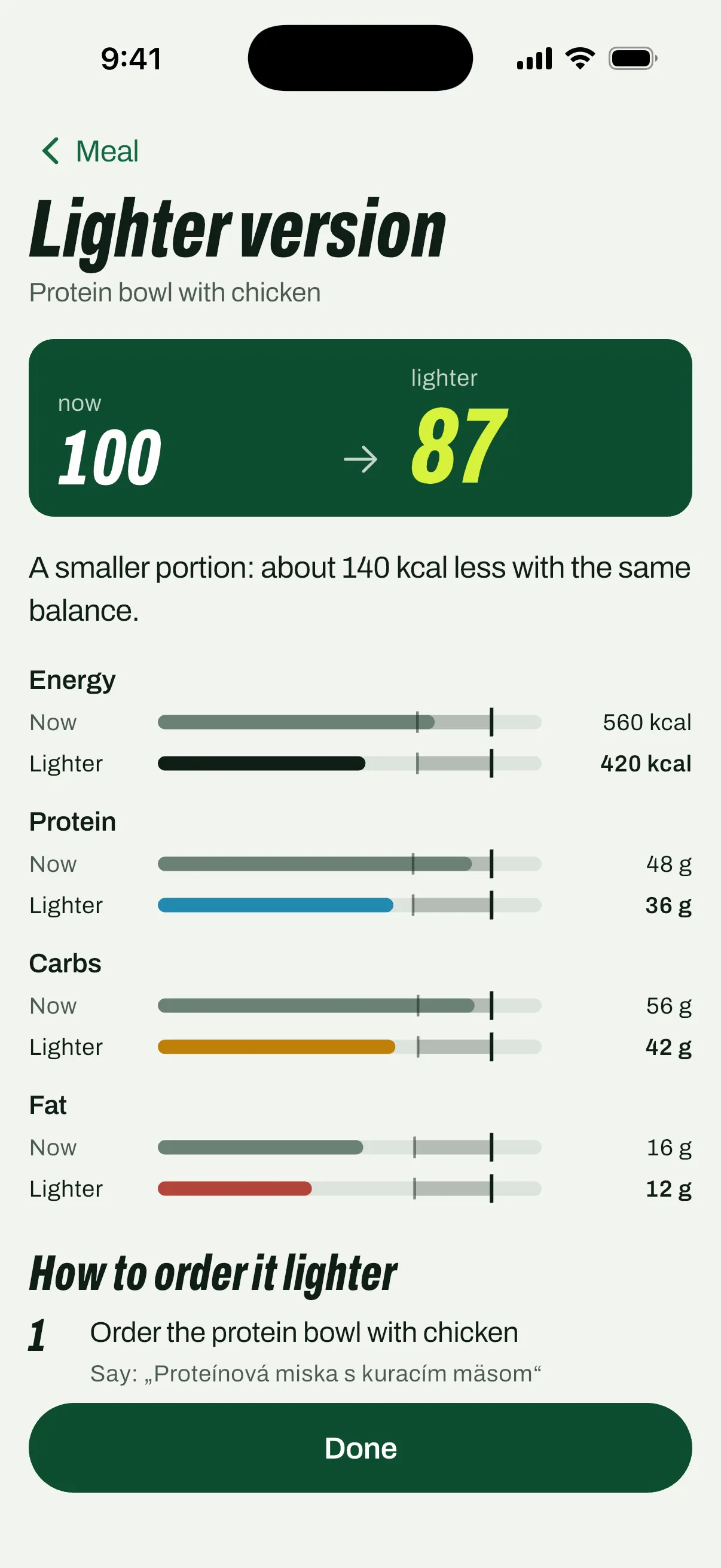
Protein gets the same weight as calories. Every meal has a protein target in grams, and a dish with less protein than the target gets a lower match score. For people who train, that’s more useful than watching calories alone.
Restaurant values are estimated from the menu text and portion weight, since restaurants rarely publish them. The app doesn’t hide this and shows how confident each estimate is. How much dishes differ is shown in our analysis of over 10,000 lunch-menu dishes.
Logging and Progress
Every dish in the app has a + button that logs it to your day. Food from home can be logged from a list of common foods, by typing, or with a photo that the app estimates calories from.
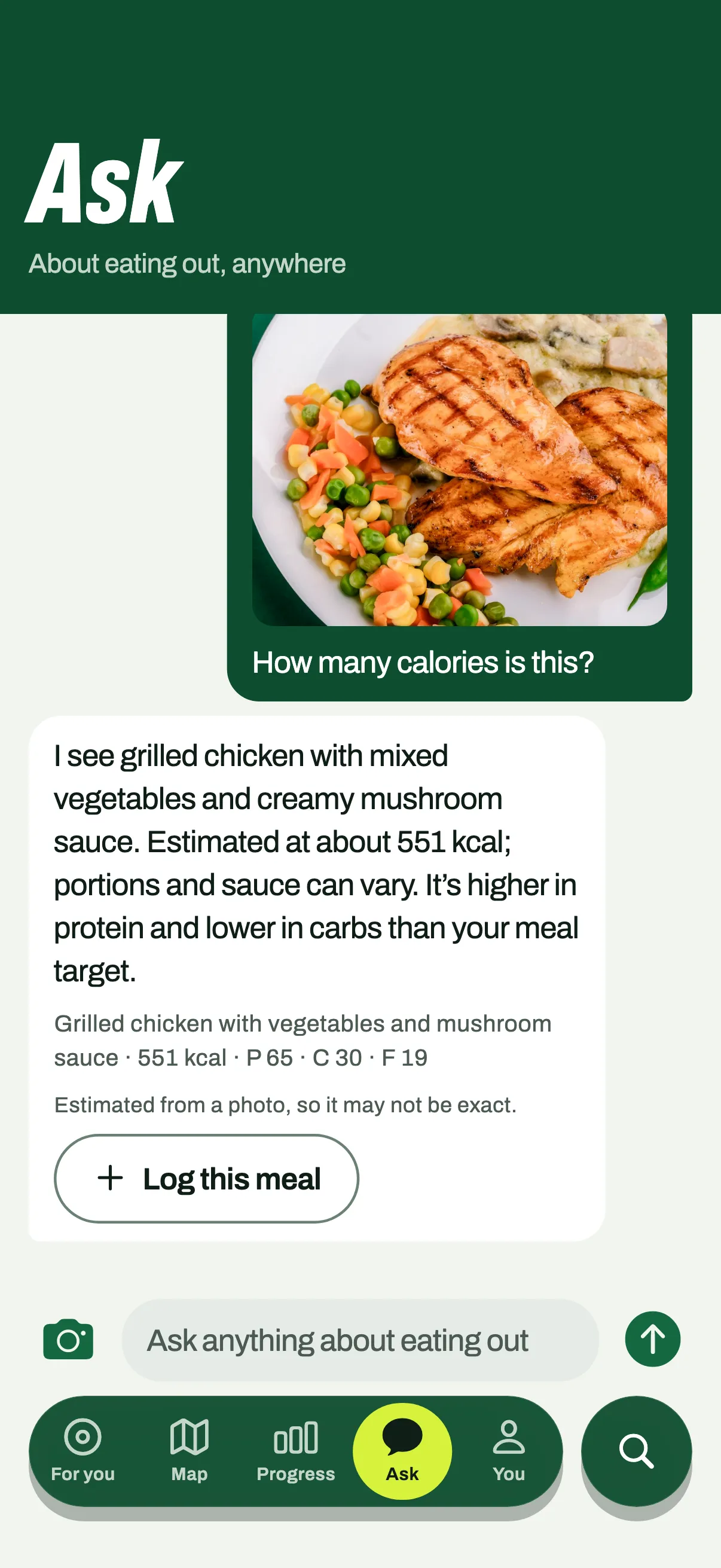
Progress shows the day, the week and the month. The day view shows the calories left to the target, how they split between meals, and a table of macros. A streak of logged days encourages regular logging.
Diets and allergies
In settings you pick allergens from the 14 EU allergens, a diet (keto, vegan, vegetarian, pescatarian or carnivore) and foods you want to avoid. The app follows them in every recommendation and flags allergens on dishes.
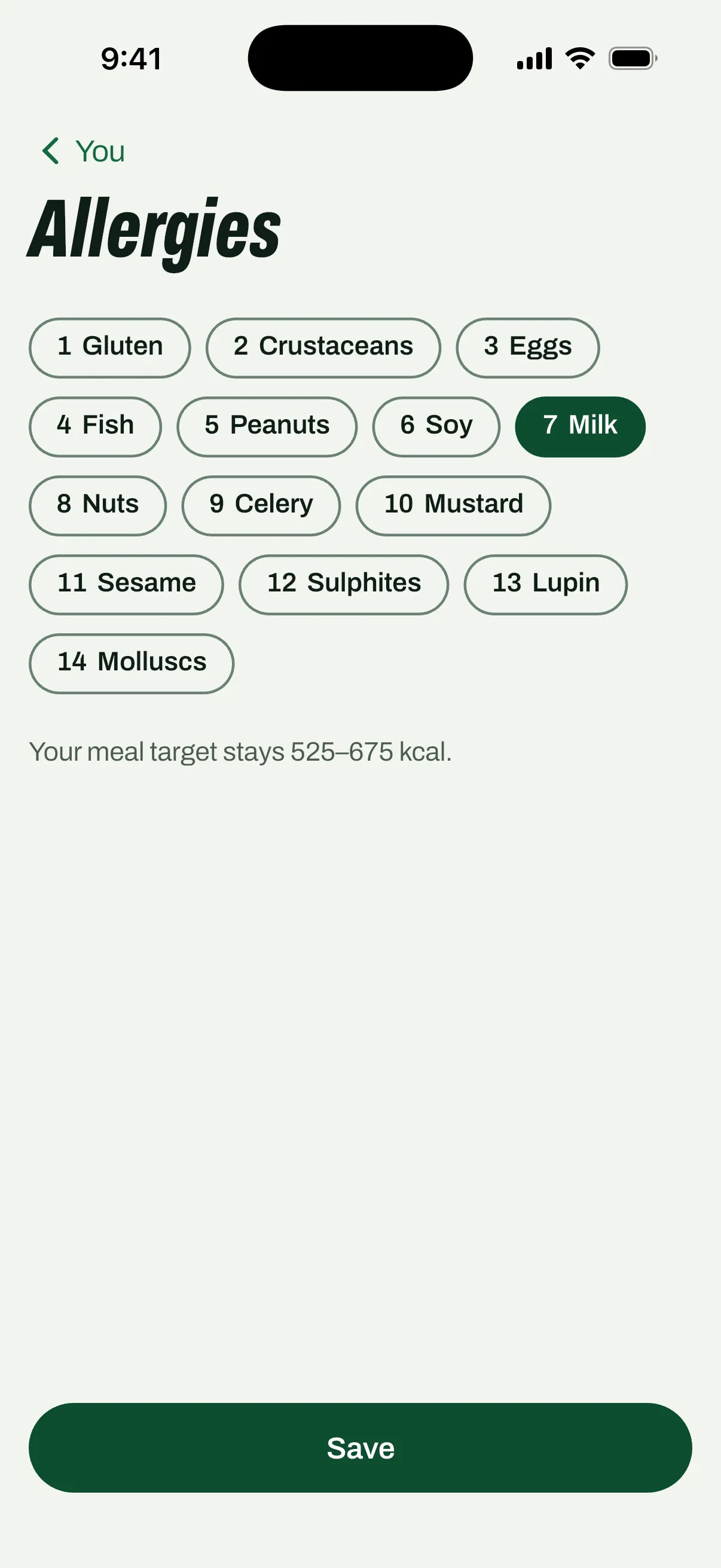
Allergens on restaurant dishes are also estimated from the menu text unless the restaurant states them. With a serious allergy, check the dish with the restaurant.
The web demo and the real app
The NourFit website has an interactive demo that uses the same target maths and the same dish ranking as the app. Its restaurants are invented, so it shows the idea well but not what’s near you. The real app works with nearby restaurants and their current menus.
Strengths
- It recommends a specific dish at a specific restaurant, not general tips.
- It works with lunch menus, the everyday lunch in Slovakia.
- Protein has its own target for every meal.
- It follows allergies, diet and foods you want to avoid.
- It shows openly how reliable each estimate is.
- It works in English, Slovak and Czech and needs no account.
Limitations
- It covers restaurants in Slovakia only, most densely in the big cities.
- Calories and allergens for restaurant dishes are estimates.
- It has no barcode scanner and no large database of packaged food.
- It doesn’t track vitamins, minerals or exercise.
- It’s a new app with no store ratings yet.
What’s free and what needs Pro
NourFit is free to download. Without a subscription it shows the 10 nearest restaurants in each view plus 3 more favourite places, opens the full menu of 5 restaurants a day, and shows lunch menus as lists of dishes with calories, fit and allergen warnings. Logging is unlimited, Progress covers the current week, and each week there are 3 photo estimates and 3 typed AI food checks.
Pro unlocks every restaurant and menu, lunch-menu dish details, lighter versions, the Ask tab, unlimited photo estimates and the full Progress history. The App Store shows the price.
Who should use NourFit
It pays off most for someone in Slovakia who eats out at least a few times a week and wants to lose weight or build muscle without counting and guessing. It also works alongside another tracker, because logging in NourFit is optional.
Someone who eats almost only at home, needs to scan packaged food or tracks vitamins and minerals will be happier with a general app. See our comparison of calorie tracking apps.
Verdict
NourFit takes on the job other calorie trackers leave to the user. At a restaurant it says what to order and why. It works best for people who often eat out in Slovakia and have a clear goal. With protein, allergies and lighter versions, it goes further than a calorie number.
Its limits come from its focus. Outside Slovakia and for food from the shop it helps less. For what it’s built to do, choosing a dish at a Slovak restaurant, it’s the most practical app we know of.
Sources
- A new predictive equation for resting energy expenditure in healthy individuals. Mifflin, St Jeor et al., American Journal of Clinical Nutrition, 1990.
- Calorie counting made easy. Harvard Health Publishing.
Get NourFit
NourFit is free to download on iPhone, and the Android version is coming soon. To try it first without installing anything, open the demo right here on the site.
Get NourFit on the App Store. The Android version is coming soon to Google Play.